This guide explains Social Security Disability Listings 2.02, 2.03, and 2.04, the vision impairment listings. The Listings are a set of medical criteria. If your records show you meet one of them, you automatically meet the medical requirements for Social Security Disability.
These listings cover conditions like:
- Cataracts
- Diabetic retinopathy
- Glaucoma
- Macular degeneration
- Retinitis pigmentosa
- Tunnel vision
- Optic nerve atrophy
- Cortical visual impairment
Statutory blindness vs. meeting a listing. Only Listings 2.02 and 2.03A qualify as statutory blindness under the Social Security Act. Listings 2.03B, 2.03C, 2.04A, and 2.04B can still get you approved for disability, but they do not give you statutory blindness status. That distinction matters for things like the SSI resource rules and the trial work period.
Listing 2.02: Loss of Central Visual Acuity
The rule: Remaining vision in the better eye after best correction is 20/200 or less.
When you are wearing your glasses or contacts, is your vision 20/200 or worse in the better eye? If yes, you meet this listing.
But there is more. Your vision can be significantly better than 20/200 and still meet 2.02. According to SSA's own explanation (Listing 2.00A5b), as long as you cannot read any of the numbers or letters along the 20/100 line of your eye exam, you still meet this listing.
Why the eye chart matters
Listing 2.02 assumes your eye exam was taken with a Snellen eye chart. Here is what a Snellen chart looks like:
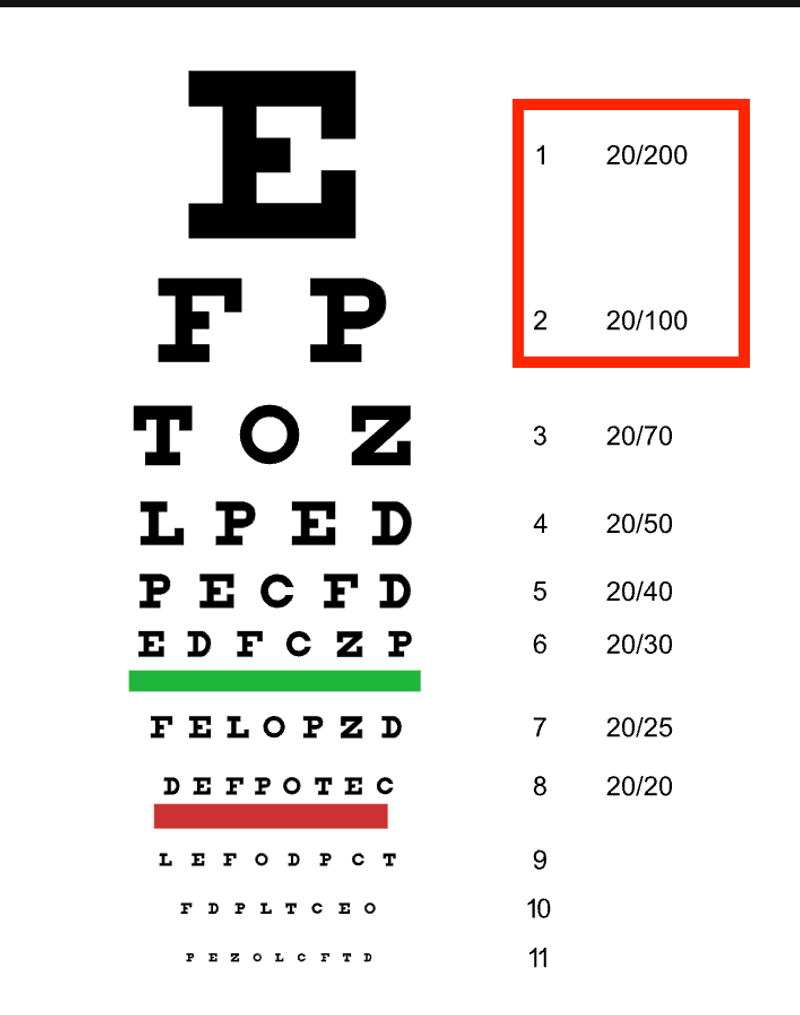
Notice the big jump from 20/100 to 20/200. Other charts, like the Bailey-Lovie or the Early Treatment Diabetic Retinopathy Study (ETDRS), have lines that measure visual acuity between those points.
Here is what a Bailey-Lovie test looks like:
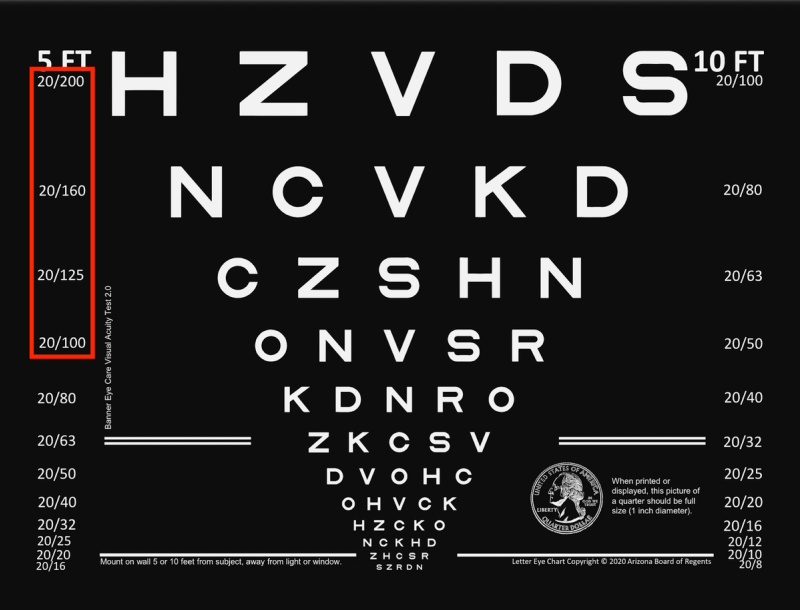
Notice the 20/125 and 20/160 lines. Your vision could be as good as 20/125 and you would still meet Listing 2.02. What matters is that you cannot read any of the letters on the 20/100 line.
Reading the abbreviations on your eye exam
Eye exams use special abbreviations for eyes with very low or no vision. If your exam reads any of these for an eye, your best-corrected vision is less than 20/200 in that eye:
- CF — counts fingers
- HM — hand movement
- LP or LPO — light perception or light perception only
- NLP — no light perception
Listing 2.03: Contraction of the Visual Field
Listing 2.03 has three different ways to qualify, labeled A, B, and C. You only need to meet one of them.
Listing 2.03A: Widest diameter of 20 degrees or less
The rule: Contraction of the visual field in the better eye, with the widest diameter subtending an angle around the point of fixation no greater than 20 degrees.
You need a Humphrey Field Analyzer (HFA) 30-2, HFA 24-2, or an Octopus 32 test to meet this listing. We are going to focus on the Humphrey 30-2 since it is the most widely used.
Here is what a Humphrey 30-2 results page looks like:
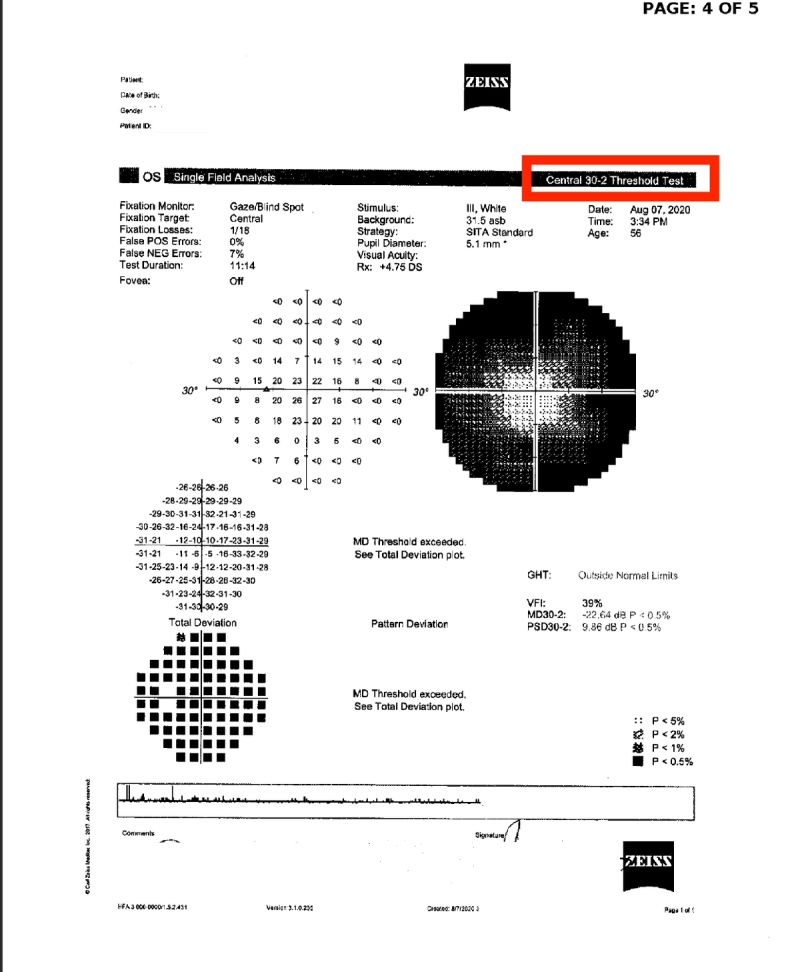
You know it is a Humphrey 30-2 because the test result page says so. I have highlighted that area of the form with a red box.
For 2.03A, what we care about is the large diagram on the middle left with the crosshairs and all the numbers, known as the dB printout:
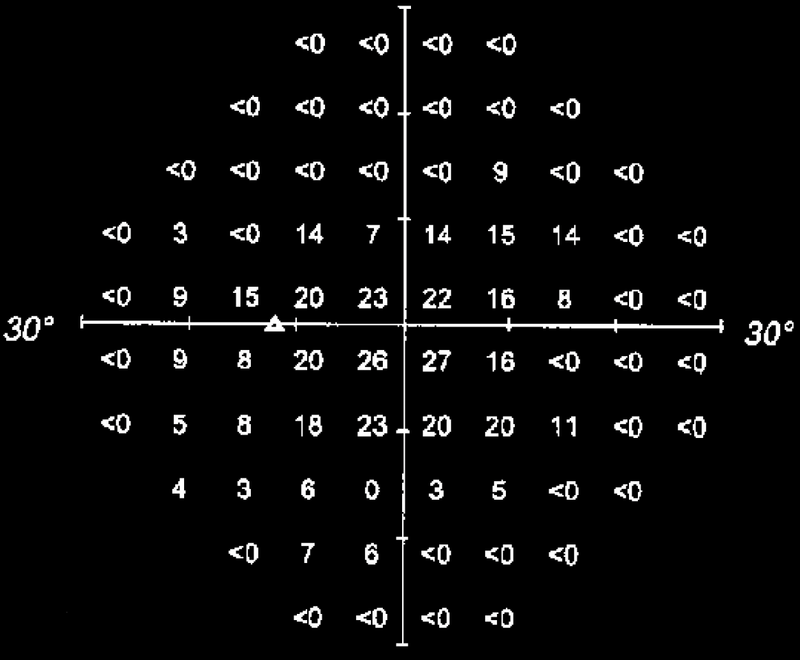
All of the numbers on the grid reflect the dB (decibel) values for the portion of the visual field tested. Decibels measure the eye's sensitivity to light. For Listing 2.03A:
- Results less than 10 dB are non-seeing points
- Results 10 dB and above are seeing points
- The 30-degree symbols on both sides of the chart indicate the test measures 30 degrees of the field of vision
- The point of fixation is the center point of the crosshairs
Calculating the widest diameter
You meet 2.03A if the widest diameter subtending an angle around the point of fixation is no greater than 20 degrees. To find that diameter:
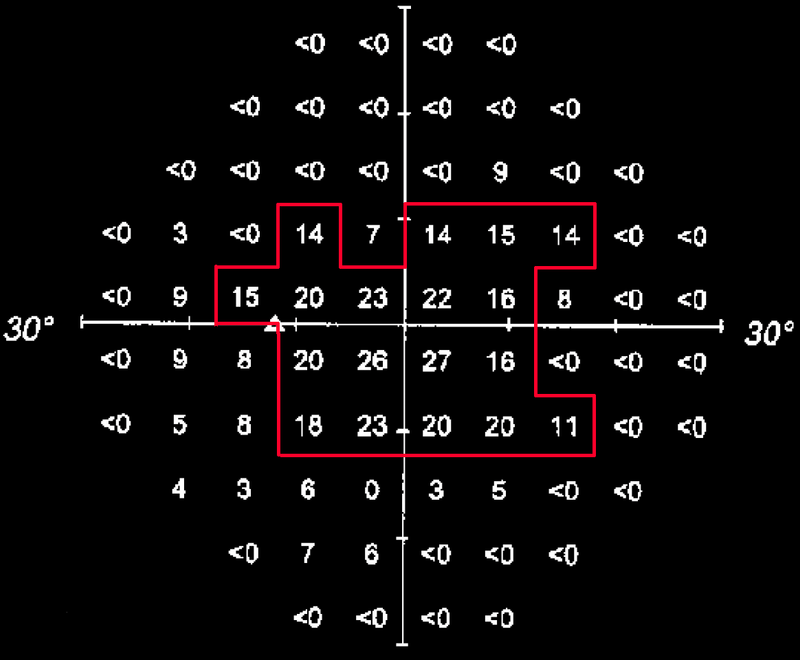
Step 1. Box off all the values that are below 10 from those above 10:
Step 2. Draw the longest line possible that goes through the point of fixation and stays inside the boxed area:
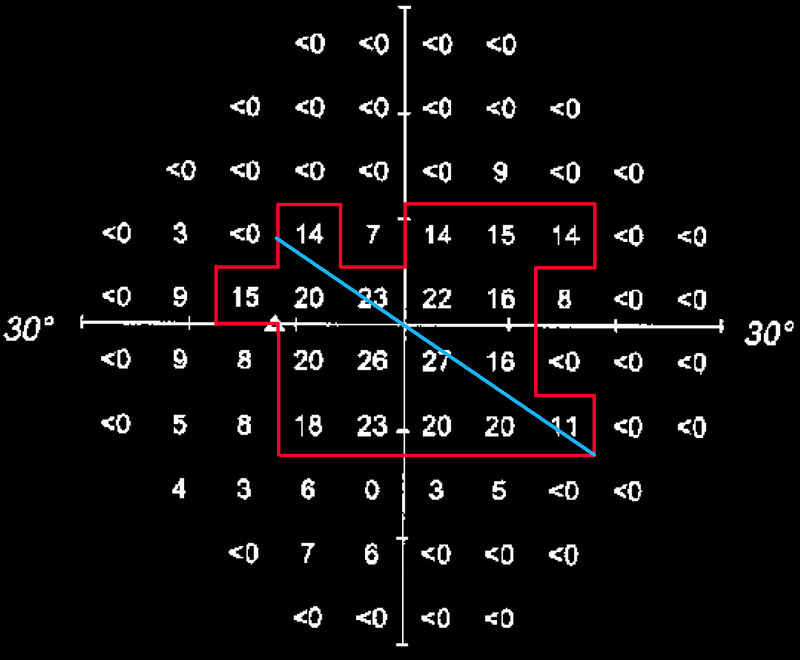
Step 3. Measure that line using the Pythagorean theorem (A² + B² = C²). Each square on the chart is six degrees tall and six degrees wide.
In this example:
- Horizontal leg: 5 squares × 6 degrees = 30 degrees
- Vertical leg: about 3⅓ squares × 6 degrees = 20 degrees
- 30² + 20² = 900 + 400 = 1,300
- The square root of 1,300 is about 36
So the widest diameter through the point of fixation is roughly 36 degrees. SSA requires 20 degrees or less, so this person does not meet 2.03A.
Quick rounding note. If your line measures a decimal point above 20, SSA rounds down to 20.
Reliability requirements for the Humphrey test
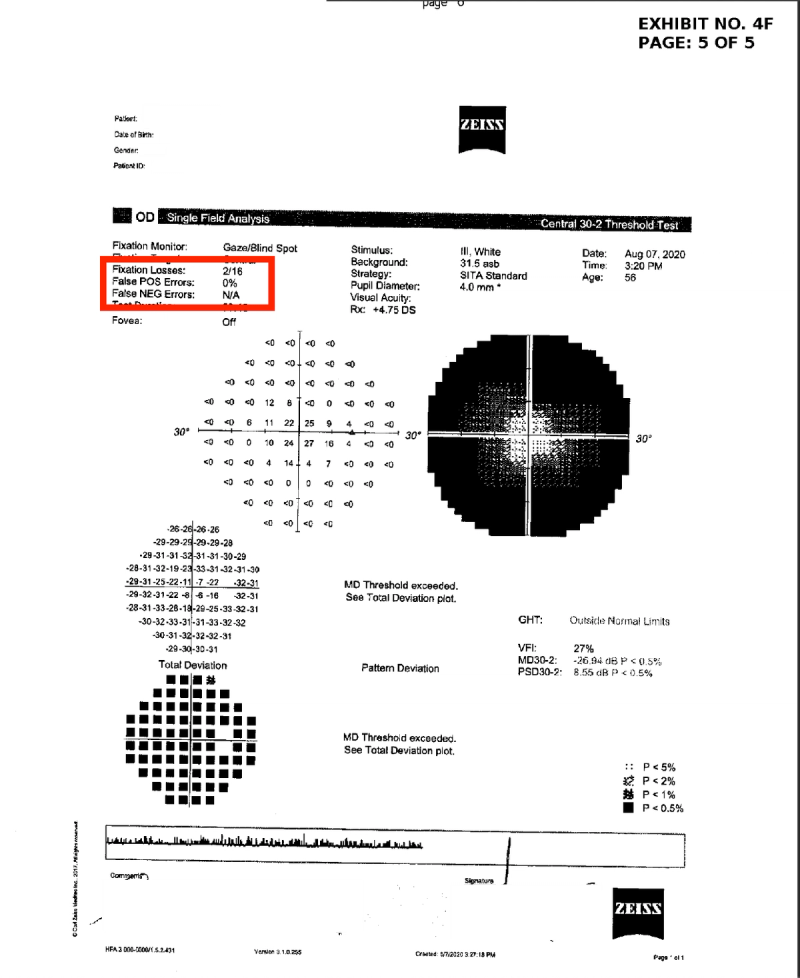
For your test results to count, the exam needs to meet all three of these reliability thresholds:
- Fixation losses no greater than 20%
- False positive errors no greater than 33%
- False negative errors no greater than 33%
If any of those numbers are higher, SSA will treat the exam as unreliable and discard it. Here is where to find those scores on your exam:
The full SSA explanation of how to evaluate 2.03A lives in Section 2.00A6 of the Bluebook.
Listing 2.03B: Mean deviation of 22 dB or greater
The rule: Contraction of the visual field in the better eye, with an MD of 22 decibels or greater, determined by automated static threshold perimetry that measures the central 30 degrees of the visual field.
Important: You need a Humphrey 30-2 for 2.03B specifically. The HFA 24-2 cannot be used because it does not measure the full central 30 degrees of the visual field. SSA spells this out in Section 2.00A6d.
Here is where you find the MD on your test result page:
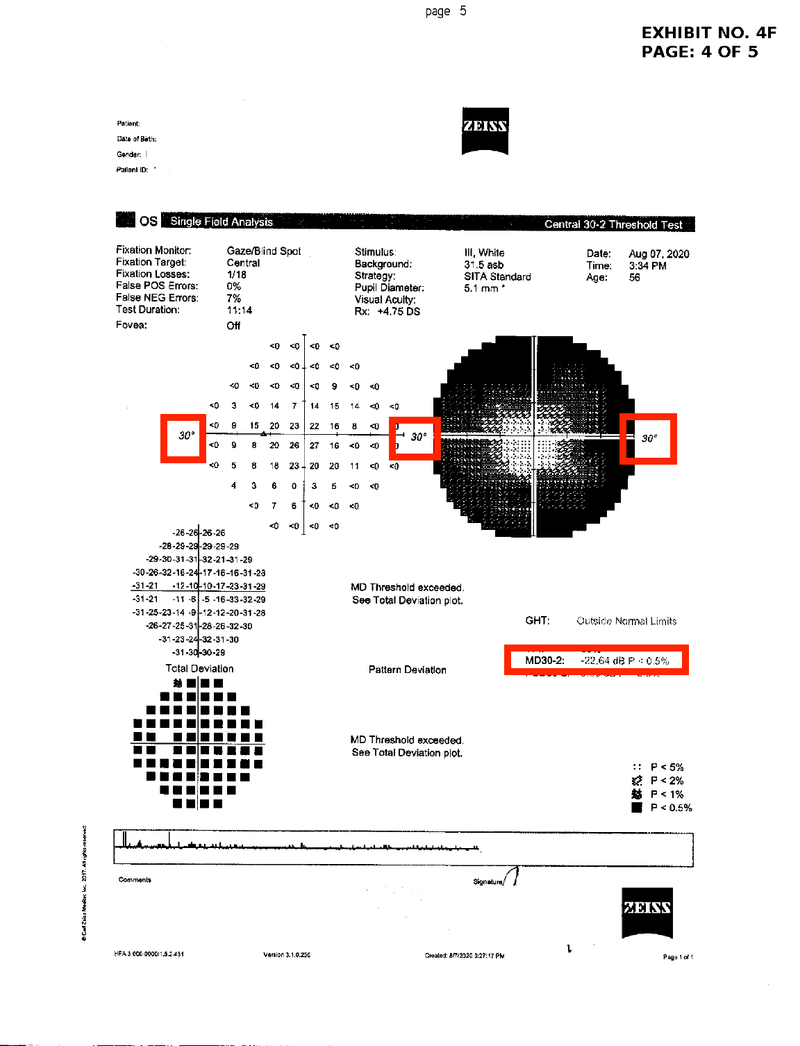
A closer look at the MD findings:
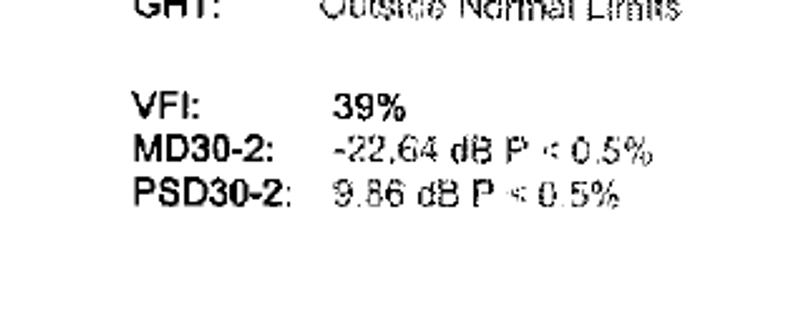
MD stands for mean deviation. In this example, the dB value reads -22.64. SSA uses the absolute value, so 22.64. Since the MD is above 22 dB, this person meets the listing.
Watch your birthday. Make sure your correct birthday is on the exam results, since age is a factor in the MD calculation. Your birthday is in the top left corner of the exam results below your name.
Listing 2.03C: Visual field efficiency of 20% or less
The rule: A visual field efficiency of 20 percent or less in the better eye, determined by kinetic perimetry.
For this listing you need a kinetic perimetry test, which looks like this:
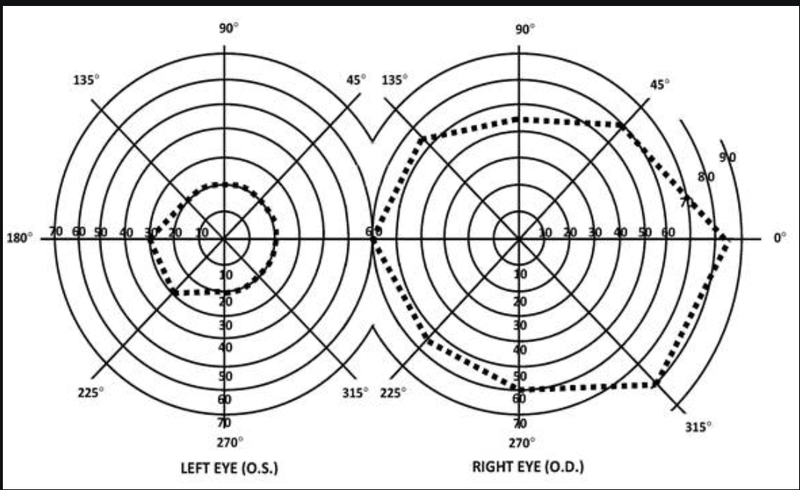
Each eye on the chart has:
- Seven concentric circles around the center of the eye
- Eight principal meridians (the lines that meet in the center)
- Each meridian is labeled by its degree on the circle: 0, 45, 90, 135, 180, 225, 270, and 315
How SSA calculates visual field efficiency
Add the number of degrees you see along the eight principal meridians in your better eye, then divide by 5.
Left eye example. The diagram shows a visual field contracted to 30 degrees in two meridians (180 and 225) and 20 degrees in the remaining six meridians:
(30 + 30 + 20 + 20 + 20 + 20 + 20 + 20) ÷ 5 = 36% visual field efficiency
Right eye example. The diagram shows 45 degrees on one meridian, 60 degrees on three meridians, 55 degrees on two meridians, 80 degrees on one meridian, and 85 degrees on one meridian:
(45 + 60 + 60 + 60 + 55 + 55 + 80 + 85) ÷ 5 = 500 ÷ 5 = 100% visual field efficiency
SSA requires 20% or less in the better eye, so this person does not meet the listing.
Get Your FREE Guide to Social Security Disability
Everything you need to know about the SSDI process, explained in plain language by Brad Thomas.
Listing 2.04: Loss of Visual Efficiency
Like 2.03, Listing 2.04 has two parts. You only need to meet one.
Listing 2.04A: Visual efficiency percentage of 20 or less
The rule: Loss of visual efficiency in the better eye, with a visual efficiency percentage of 20 or less after best correction.
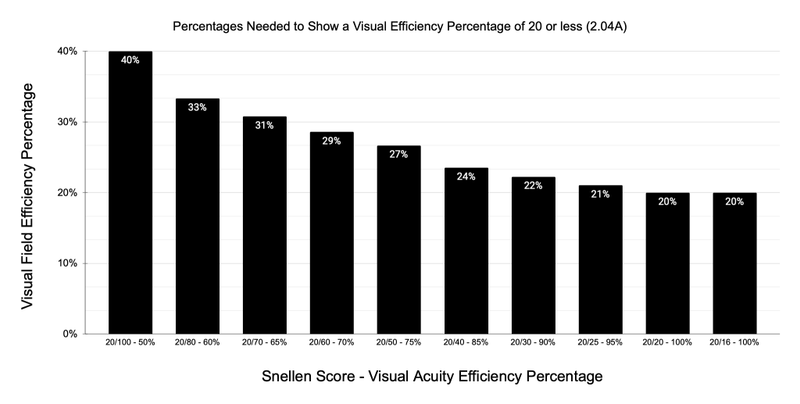
Listing 2.04A combines the data from 2.02 and 2.03C. SSA calculates your visual efficiency percentage by multiplying your visual acuity efficiency percentage by your visual field efficiency percentage and dividing by 100.
Use the method from 2.03C above to get your visual field efficiency percentage. Use this list to convert your Snellen score to a visual acuity efficiency percentage:
- 20/16 → 100%
- 20/20 → 100%
- 20/25 → 95%
- 20/30 → 90%
- 20/40 → 85%
- 20/50 → 75%
- 20/60 → 70%
- 20/70 → 65%
- 20/80 → 60%
- 20/100 → 50%
Worked example
Say you had:
- Snellen score of 20/100 (not enough to meet 2.02)
- Visual field efficiency of 25% (not enough to meet 2.03C)
Convert the Snellen score to 50% using the list above. Multiply by 25%:
50 × 25 = 1,250 → 1,250 ÷ 100 = 12.5%
That is below 20%, so you meet Listing 2.04A even though you didn't meet either of the underlying listings on its own.
Here is the graph of minimum values needed to meet 2.04A:
Listing 2.04B: Visual impairment value of 1.00 or greater
The rule: Loss of visual efficiency in the better eye, with a visual impairment value of 1.00 or greater after best correction.
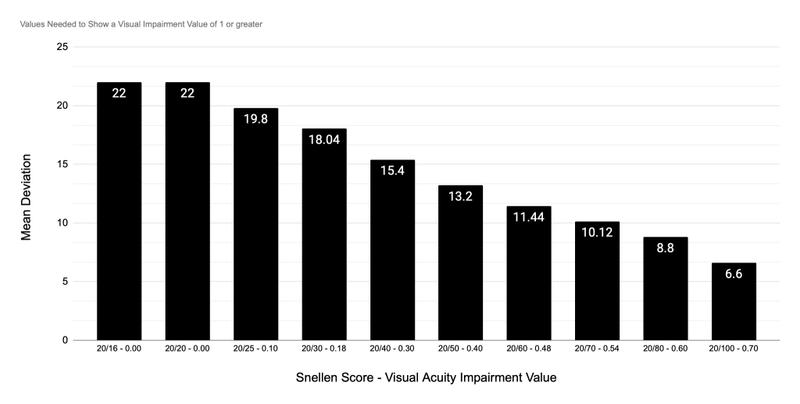
Listing 2.04B combines the data from 2.02 and 2.03B. SSA calculates the visual impairment value by adding your visual acuity impairment value and your visual field impairment value.
Use this list to convert your Snellen score to a visual acuity impairment value:
- 20/16 → 0.00
- 20/20 → 0.00
- 20/25 → 0.10
- 20/30 → 0.18
- 20/40 → 0.30
- 20/50 → 0.40
- 20/60 → 0.48
- 20/70 → 0.54
- 20/80 → 0.60
- 20/100 → 0.70
To get your visual field impairment value, take the absolute value of your MD (from 2.03B) and divide by 22.
Worked example
Say you had:
- MD of -18 dB (not enough to meet 2.03B)
- Snellen score of 20/80 (not enough to meet 2.02)
Take the absolute value of -18, which is 18. Divide by 22:
18 ÷ 22 = 0.81 (visual field impairment value)
Convert the Snellen score using the list:
20/80 = 0.60 (visual acuity impairment value)
Add them together:
0.81 + 0.60 = 1.41
Listing 2.04B requires 1.00 or greater, so 1.41 meets the listing.
Here is the graph of minimum values needed to meet 2.04B:
What to Do If You Think You Meet a Listing
If you have any of the eye conditions listed above and your test results look close to the numbers in this guide, do not try to figure it out alone. Get the actual exam reports from your eye doctor (the Snellen chart results, the Humphrey 30-2 printout, or the kinetic perimetry chart) and bring them to a disability attorney. The right exam in the file is often the difference between an approval and a denial.
If you want help, give my office a call at (972) 863-2367 for a free case evaluation.

About the Author
Brad Thomas
Social Security Disability Attorney
Brad Thomas is the founder of Brad Thomas Disability PLLC in Plano, Texas. With 9+ years of experience and an 89.2% win rate for clients over 50, he has dedicated his career to helping people navigate the Social Security Disability process. Brad is a Baylor Law graduate and has been recognized as a Super Lawyers Rising Star from 2017 to 2024.
Read Brad's full bioNeed Help With Your Disability Claim?
Take our free 60-second evaluation to see if you qualify for Social Security Disability benefits.
You Might Also Like
How Often Should You Update The SSA On Your Medical Information
Sending the SSA constant medical updates feels like it should help your case, but it usually does the opposite. Here's why holding most updates until your next appeal can actually move your claim forward faster, and the specific situations where you should pick up the phone right away.
April 21, 2023 · 5 min read
Disability Hearing Formats: In-Person, Phone, Video, and Agency Video Explained
The SSA now offers four official hearing formats for disability cases. Attorney Brad Thomas breaks down each option and explains why phone hearings usually give clients the best results.
April 18, 2023 · 5 min read
Can You Work While Applying for Social Security Disability Benefits?
Working while your disability claim is pending is usually a bad idea, but there are rules that allow limited work activity. Here's what you need to know about SGA limits and unsuccessful work attempts in 2026.
April 3, 2023 · 4 min read
This article is for informational purposes only and does not constitute legal advice. No attorney-client relationship is formed by reading this content. Each disability case is unique, and outcomes depend on individual facts and circumstances. If you need legal help with your Social Security Disability claim, please contact us for a free consultation.